Doron Appelboim - The innovator who refuses to be afraid
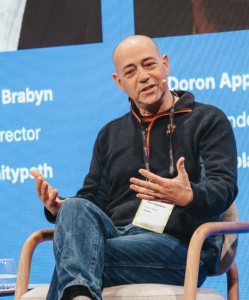
How Doron Appelboim turns curiosity, courage and hands-on experimentation into aviation innovation?
“I don’t really know how to do it,” Doron Appelboim says with a smile. “But I’m not afraid to try.”
For some people, this might sound like a casual remark. For Doron, it is closer to a philosophy of life. It explains how a child who grew up around carpentry tools, metalwork, radios and craft projects became an aviation innovator, flight test pilot, systems designer and co-founder of Aerolane.
Doron’s story is about what happens when a person never loses the childlike permission to ask: what if I tried?
In a world where innovation is often described through strategy models, funding rounds, technology roadmaps and market forecasts, Doron brings the conversation back to something more fundamental: courage, curiosity and the willingness to learn by doing.
Creativity begins in the hands
Doron grew up close to materials, tools and practical work. His grandfather had a carpentry workshop. His father had a metal shop. Later, Doron spent time in a weaving school. These were not abstract learning environments. They were places where things were made, repaired, modified and understood through touch. As a child, he took apart an old radio and connected speakers to see what would happen. He experimented, failed, adjusted and tried again.
This kind of upbringing leaves a mark. It creates a relationship with the world in which objects are not fixed and mysterious. They are understandable. They can be opened, studied, changed, rebuilt. A problem is not necessarily a wall. It may be a mechanism waiting to be understood.
Many innovators share this pattern. Before they become entrepreneurs, scientists, designers, or engineers, they are often tinkerers. They are children who learn that the world is not only something to observe, but something to participate in.
For Doron, this hands-on confidence became a lifelong attitude: “I can figure this out.” Not “I already know.” Not “I am an expert in everything.” But: “I can try and I can learn.” That distinction matters.
The attitude of “I can try”
When Doron talks about innovation, he does not begin with genius. He begins with attitude.
He is not afraid to fix plumbing. He is not afraid to do electrical work. He is not afraid to build shelves, paint, repair, test, or learn something unfamiliar. Of course, he is not reckless. If there is plumbing involved, he knows to close the main valve. If something becomes too difficult or dangerous, he calls an expert.
The starting point is not fear. The starting point is action. This may be one of the quietest but most important foundations of innovation. The belief that “I can try” changes the boundaries of a person’s life. It expands the number of doors one is willing to open.
The opposite belief — “I can’t” — closes possibilities before they have even been tested.
Doron seems to have lived much of his life on the other side of that line. Friends even gave him a nickname that roughly means the person who speaks differently, the one who sees things from another angle. For many people, being seen as different is uncomfortable. For an innovator, it may be a sign that something valuable is happening.
Innovation often begins with someone looking at the same reality as everyone else and refusing to accept the standard interpretation.
From operator insight to industry standard
Doron’s aviation career gave him a rare vantage point. He was not only designing systems from a distance. He was also operating them. As a professional operator flying unmanned systems, he was often placed in situations where the problem was new and undefined.
Engineers would ask: what functionality do you need? This is an important question, because real innovation often comes from the people closest to use. They see friction before it becomes visible in a design office. They understand what is missing because they feel the absence directly.
One of Doron’s examples was a feature that now sounds obvious: a coordinate-based camera function. The operator receives a coordinate, presses a button and the camera automatically moves to that point and tracks it.
At the time, this was not standard. It emerged from practical need. Later, similar functionality became common in the drone industry.
This is a reminder that innovation is not always born as a grand vision. Sometimes it begins as a small operational frustration. Someone doing the work notices that a system should behave differently. Someone has the courage to say it aloud.
Aviation as a discipline of reality
Doron’s current work with Aerolane is built around an idea that sounds both futuristic and old at the same time: towed aircraft.
The concept draws on principles familiar from gliders and aerodynamics. A glider with a high lift-to-drag ratio does not require much towing force to remain in the air, even with significant mass. Doron explains the logic in practical terms: instead of having many separate engines each operating inefficiently, propulsion can be consolidated. Fewer engines can work more efficiently, while towed aircraft carry useful payload.
The promise is large: lower fuel burn, reduced emissions, lower operating costs and the use of existing, non-exotic technology. No need to wait for miraculous batteries or future hydrogen infrastructure. The basic physical principles already exist.

Yet this is where innovation meets one of its most difficult borders: the system around the technology.
According to Doron, the technical proof exists. Flight tests show major savings. Customers are interested. But the barrier is not simply whether the idea can work. The question is whether institutions, rules and decision-makers can move fast enough to allow it to work in the world. This is where Doron’s story becomes larger than aviation.
Many important innovations do not fail because they are technically impossible. They fail, or stall, because existing systems do not know how to understand them.
When people do not understand, they cannot support
One of the hardest tasks for an innovator is not invention. It is translation.
Doron works at the intersection of aerodynamics, towing dynamics, engine efficiency, operations, safety and regulation. The opportunity lies in connecting these pieces in a way that makes aviation more efficient without waiting for entirely new propulsion technologies. In investor conversations, he often invites people to bring in a pilot or aviation expert they trust. Seen through that practical aviation lens, the idea becomes powerful recombination of principles the industry already understands.
This is a familiar challenge for anyone working with unfamiliar technologies. Before a serious business discussion can begin, the innovator often has to teach the basic concept. That teaching process is not a side activity. It is part of the innovation work itself.
Unexpected ideas naturally create skepticism. People do not fund, approve, regulate or adopt what they do not understand. The innovator’s task is therefore not only to build a prototype. It is to build trust.
Trust comes through evidence, clear communication, demonstrations and relationships. It requires patience. It also requires humility: the ability to explain without arrogance and to listen when others are not yet ready to see what you see.
The systems that slow down the unusual
Doron’s reflections on regulation and funding reveal a frustration shared by many innovators in Europe.
The political language often supports innovation. Societies want lower emissions, stronger defense, better logistics, new industries and technological leadership. But the practical systems designed to support innovation can be slow, complex and poorly suited to ideas that do not yet fit familiar categories.
Grant applications may demand a level of business education and bureaucratic fluency that has little to do with the quality of the idea. Bold proposals can be rejected because evaluators do not understand them. Large consortium projects may bring funding, but also slow partnerships, rigid commitments and conditions that reduce the ability to adapt.
This creates a paradox. The more original an idea is, the harder it may be to fund through systems designed to evaluate the already understandable.
Doron’s view points toward a different kind of innovation environment: one with more playgrounds. A nation that truly wants innovation should create spaces where unusual ideas can be tested early, cheaply and with an acceptance of failure. Most experiments will not become industries. But some will. And when they do, the societal return can be far greater than the cost of the failed attempts.
This is especially important because governments do not need to think like investors. They do not always need equity or direct ownership. Their return may come through jobs, resilience, new capabilities, tax revenue, industrial renewal, or public value.
If innovation is treated only as a private financial bet, many socially important ideas will never get their first real chance.
Roots and wings
One of the warmest parts of the conversation with Doron was not about aircraft at all. It was about children.
Doron has four children, each developing and being creative in their own direction. As a parent, Doron tries to avoid turning “I don’t know how” into a full stop.
If a child says they have never tried something, that is not a reason to avoid it. It is a reason to begin. There is a Finnish expression that captures this well: children need both roots and wings. Roots give stability, identity and values. Wings give freedom, courage and permission to explore.
Creativity grows especially from the wings. Doron’s parenting philosophy seems close to his innovation philosophy. Encourage people enough safety to try. Love and enjoy the mistakes. Let them discover that capability is often created through action, not before it.
This also raises a much bigger question: what happens to creativity as people grow up?
Children are often naturally experimental. They draw, build, invent games, combine materials, ask impossible questions and imagine worlds without first asking whether the business model works. Then, gradually, education and culture begin to narrow the field. There are right answers, standard assignments, expected outputs.
Even practical subjects such as cooking or carpentry can be taught in a way that limits imagination. Everyone makes the same soup. Everyone builds the same shelf. The deeper question – what would you like to create? – is often missing.
If societies want more innovators, they may need to protect more of that early freedom.
Running on water
Perhaps the most revealing story about Doron is his side project: trying to run on water. He has researched the required speed, possible shoe designs, water conditions and special attachments. He has built equipment. He tests when the season allows it. The goal is not merely to splash and fall, but to make measurable forward progress somewhere between walking and running.
He is not trying to raise funding for it. He does not want the project trapped by investor expectations. He keeps it as a playground, a space where curiosity can remain free.
At first, running on water sounds like a joke. But in Doron’s life, it works as a metaphor. It shows the value of pursuing an idea before it is respectable. It shows how play can carry serious creative energy. It shows that not every experiment needs immediate commercialization to be worthwhile.
And yet Doron also sees the possibility that, one day, such an idea could become something larger: a sport, a tourism concept, a manufacturing niche, a training method, a small industry. The point is not that every playful idea becomes a business. The point is that without play, many future possibilities never even appear.
The world often asks innovators too early: what is this for? Sometimes the better first question is: what can this become?
Creativity is not a department
Doron’s view of creativity also has implications for organizations. If people are reduced to mechanical repetition, like Charlie Chaplin on the production line, they lose more than motivation. They lose the sense that their own initiative matters.
Managers who want innovation cannot simply demand ideas from people who have been trained to suppress initiative. They must create room for experimentation, autonomy and self-driven improvements. The same principle that applies to children also applies to adults: roots and wings.
People need enough structure to feel safe and enough freedom to try.
This may be one of the most overlooked aspects of innovation culture. Creativity is not something that appears because an organization holds a workshop. It grows when people repeatedly experience that their observations matter, their experiments are allowed and their unusual ideas will not be dismissed too quickly.
The courage to remain curious
Doron Appelboim’s career includes aviation, unmanned systems, flight testing, systems design and ambitious new approaches to air cargo. But the most interesting thread running through his story is not technical. It is human.
He has kept alive a rare combination: practical skill, intellectual curiosity and freedom from excessive fear. He is willing to look different. He is willing to try before knowing exactly how. He is willing to build, test, explain and keep going when others do not yet understand.
This does not mean ignoring risk. Aviation does not forgive carelessness. Physical systems demand discipline. But Doron’s example suggests that discipline and play are not opposites. The best innovators may need both: the seriousness to respect reality and the imagination to challenge it.
In the end, innovation may not begin with a breakthrough technology, a funding decision, or a strategic plan. It may begin much earlier, in a workshop, with a child taking apart a radio.
Or later, with an adult standing at the edge of the water, preparing to test something that still sounds impossible. Not because he already knows it will work. But because he is not afraid to try.